There are many elements that make up a film, but sound is everything. Before technology advanced we could only make silent films, but now that we can include sound, in my opinion, the films and TV shows are much better. Sound does so much on screen, whether it is dialogue conveying information to the audience, sound effects making it feel more real, or the soundtrack dictating the mood of a scene.
For horror films in particular, the soundtrack is instrumental in creating the suspense and fear that makes them successful. Horror movies would not be nearly as effective or perceived as well-made films without good music accompanying each scene. If a character alone at night was shown with light and happy music in the background, the audience would not fear for their life. If the same character was shown in the same situation but with dark and creepy music, most audience members would guess that they were about to die.
John Carpenter’s Halloween (1978) is no exception to this practice, and makes very good use of sound throughout the film. The opening credits are accompanied by high-pitched short staccato piano notes designed to raise fear in the audience and make them anxious for what is coming. This same music appears throughout the film in tense scenes where Michael Myers is stalking someone, and even though for most of the first two thirds of the movie his actions do not escalate to violence, the fear that they will is present in the minds of the audience members because of the music. Each time the camera follows someone or something and reveals that Myers is doing the same, the audience hears a distinct 3-note trill, also very high-pitched and short to be more effective in generating fear.
As someone who enjoys listening to soundtracks, I pay close attention to how the music affects me. When I listen to my favorite movie scores, I can usually tell exactly what scene each song was used for because I can connect the feelings it evokes in me with what I felt when watching the movie. Even without having seen Halloween before, the soundtrack worked very well to influence my emotions. Everytime the familiar Halloween theme played, I became anxious and worried about what might happen next. Often, nothing did, which just made me more agitated about the next scene. The music constantly made me watch the shadows or the background of the scene for Myers, because I knew he had to be there—and yet, sometimes he was not. Throughout the film, I noticed that sometimes the creepy music makes it all about what you do not see.
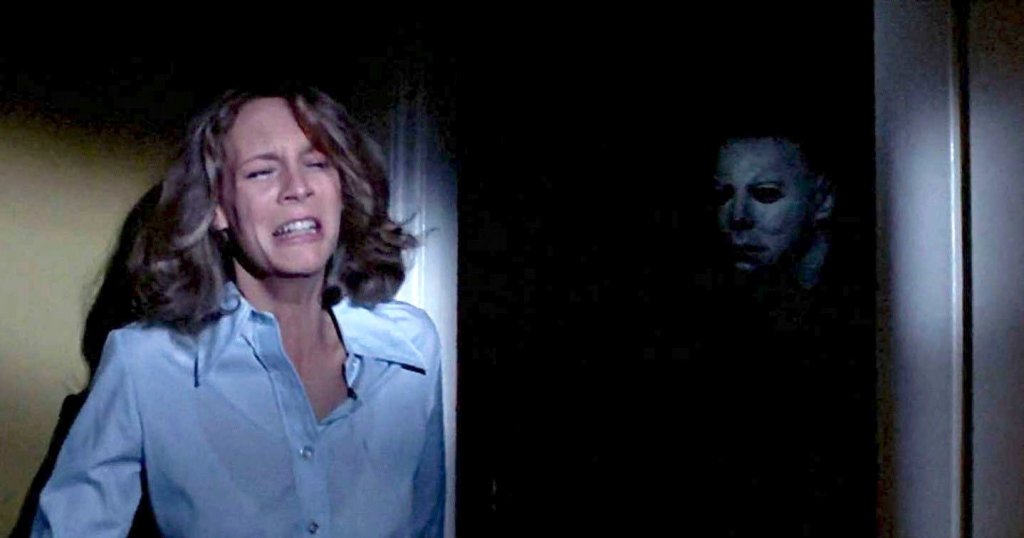
The absence of sound is very important, too. A few scenes in the movie were completely devoid of an accompanying soundtrack, instead focusing on natural sounds like footsteps and the rustling of clothes. Sometimes this was just because nothing “scary” was happening or about to happen, but other times the silence built up tension so that when Myers appeared in the shadows with his signature 3-note melody, the audience is terrified. A specific scene that made use of this was when Jamie Lee Curtis’ Laurie Strode was horrified upon seeing her friends’ bodies and Myers’ white mask is just barely visible behind her in the dark doorway.
Another effective use of sound in the movie was a repeated heavy breathing whenever the camera was in Myers’ point of view. The breathing was first introduced in the very first scene when Myers put on the clown mask and killed his sister. Every instance later where the camera follows Myers stalking someone, such as when Tommy Doyle is walking home from school, the audience cannot see Myers’ face but can hear the same heavy breathing which reminds them of the first scene and indicates that something bad is about to happen. At the end of the movie when Myers’ has inexplicably survived multiple stabbings, shootings, and a fall from a balcony, the audience hears the heavy breathing with increasing volume so that even though the immediate danger is over for the main characters, there is still the fear that something more will happen or that Myers might even show up in the real world.
Horror films would be much less effective in scaring audiences without carefully chosen sounds. While natural sounds are important too, it is the composed soundtrack that has the most impact on the audience. If a horror film played cheerful music the entire time, it would not be as successful in creating fear. It might work for quick jump scares since the audience would not be expecting anything, but the thing that makes horror movies great is their suspense and lasting fear. Good horror movies make the audience scared throughout the film, not for a split second after someone jumps out of the shadows. Movies like Halloween make excellent use of soundtracks to keep their audience scared for the entirety of the film and well beyond.
 Film, Gender, and Sexuality
Thank you Tara for sharing this post! I really enjoyed reading about the sound of this film; because it is such an important element of this film that hasn’t been discussed in our blogs so much. The sound and the sound added in post is so critical. I feel as though the music of this film is synonymous with this film, and you’re right, the music is completely what makes this scarier. Without the music, a slasher film would be less scary – there would be no anticipation. I think that Michael, as a patriarchal character, having intense creepy breathing is, just that: creepy! As a woman, I hate it. You’re so absolutely right.
LikeLike